Water conservation is an essential consideration when designing and managing Sonoma and Marin County landscapes. Our area enjoys a Mediterranean climate characterized by wet winters and long, dry summers with little rainfall. Plants that are suited or adapted to local conditions not only use less water but generally grow more successfully and robustly, with fewer insect and disease problems. They ultimately create a healthier, more beautiful and more sustainable landscape.
Below is a hand selected plant list for Sonoma and Marin counties that displays mostly native species that will thrive in our climate. You can search, filter and save specific plants to your plant list and also print plant cards.
-
Dymondia
Dymondia margaretae -
Hens and Chicks
Echeveria spp. & cvs. -
California Native
California Fuchsia
Epilobium [Zauschneria] canum -
California Native
Beach Aster, Seaside Daisy
Erigeron spp. -
California Native
Buckwheat
Eriogonum spp. -
California Native
Common Woolly Sunflower
Eriophyllum lanatum -
Wallflower
Erysimum spp. -
California Native
California Poppy
Eschscholzia californica -
Evergreen Eunonymus
Euonymus japonicus -
Spurge, Euphorbia
Euphorbia spp. -
Pineapple Guava
Feijoa (Acca) sellowiana -
California Native
Fescue
Festuca spp.
Dymondia
Dymondia margaretae
Ground Cover
Care:
Full Sun
Partial Shade
Low
Well Drained
Look:
Small
size
Gray Green
leaves
Yellow
flowers
Dymondia
Dymondia margaretae
Ground Cover
Care:
Full Sun
Partial Shade
Low
Well Drained
Look:
Small
size
Gray Green
leaves
Yellow
flowers
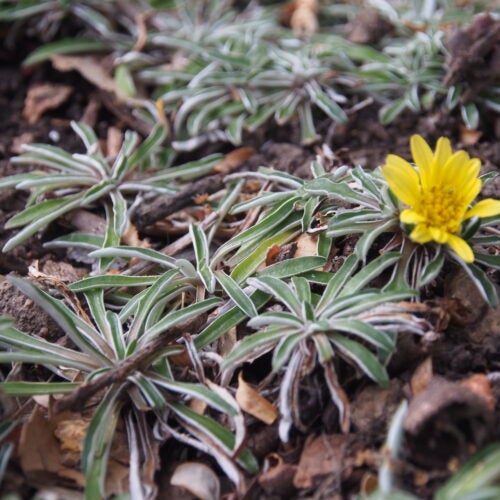
Perennial, low-growing, grayish-green groundcover from South Africa that grows to 1-3” tall and spreads to about 1-3’ over time. Yellow, daisy-like flowers add to the interest of this plant in the summer. Excellent between pavers or planted in mass to cover larger areas as a drought tolerant lawn alternative. Can withstand light foot traffic. Sun along the coast, light shade inland, well-drained soils.
Hens and Chicks
Echeveria spp. & cvs.
Succulent
Care:
Full Sun
Partial Shade
Low
Well Drained
Look:
Small
size
Blue Green
leaves
Gray Green
leaves
Green
leaves
Multi
flowers
Orange
flowers
Pink
flowers
Red
flowers
Yellow
flowers
Hens and Chicks
Echeveria spp. & cvs.
Succulent
Care:
Full Sun
Partial Shade
Low
Well Drained
Look:
Small
size
Blue Green
leaves
Gray Green
leaves
Green
leaves
Multi
flowers
Orange
flowers
Pink
flowers
Red
flowers
Yellow
flowers
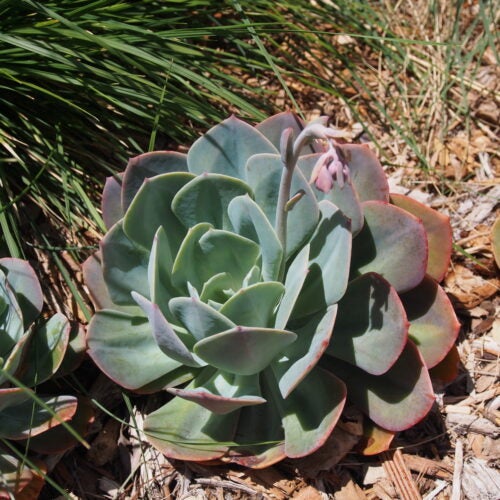
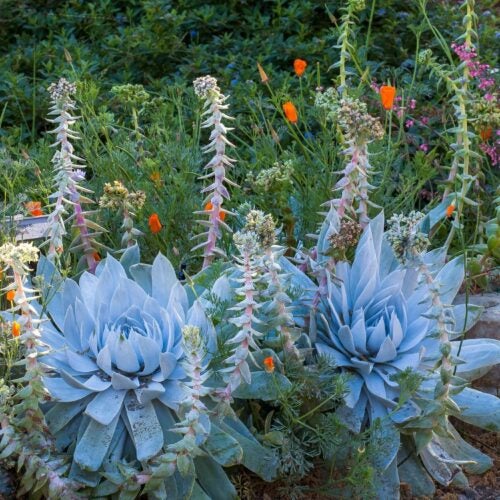
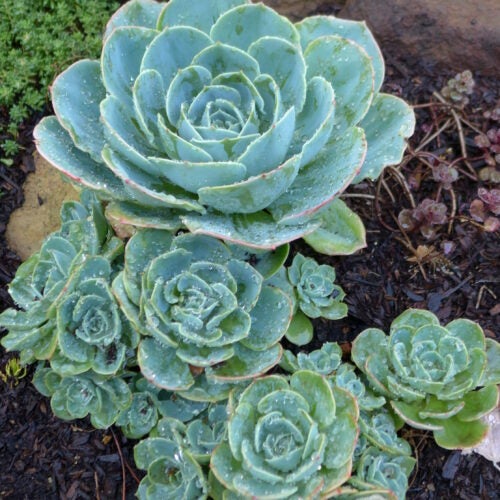
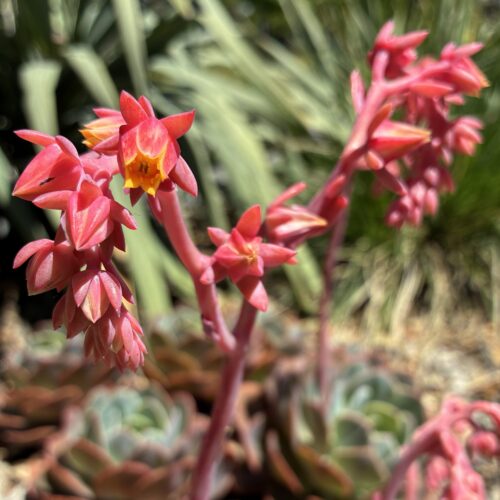
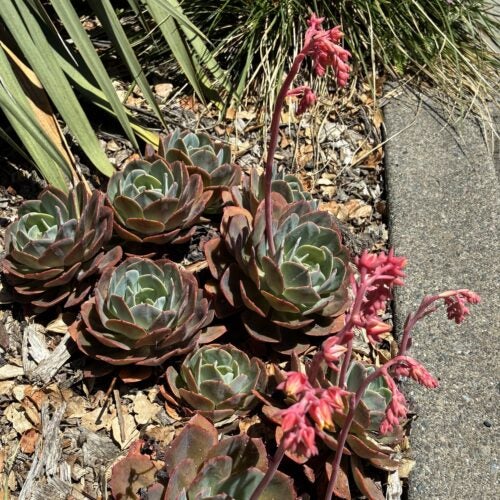
Echeveria (Hens and Chicks) succulents grow as rosettes of green to gray-green or bluish gray leaves and nodding, bell-shaped flowers on tall stems in spring or early summer. Some species spread to form multiple rosettes, others remain solitary. Native to rocky outcrops in semi-arid parts of Mexico, Central America, and northwestern South America, hundreds of cultivars can be found. Plant in cool sun or afternoon shade, with good air circulation and excellent drainage.
California Fuchsia
Epilobium [Zauschneria] canum
CA Native, Ground Cover
Care:
Full Sun
Low
Well Drained
Look:
Small
size
Gray Green
leaves
Green
leaves
Orange
flowers
Pink
flowers
Red
flowers
California Fuchsia
Epilobium [Zauschneria] canum
CA Native, Ground Cover
Care:
Full Sun
Low
Well Drained
Look:
Small
size
Gray Green
leaves
Green
leaves
Orange
flowers
Pink
flowers
Red
flowers
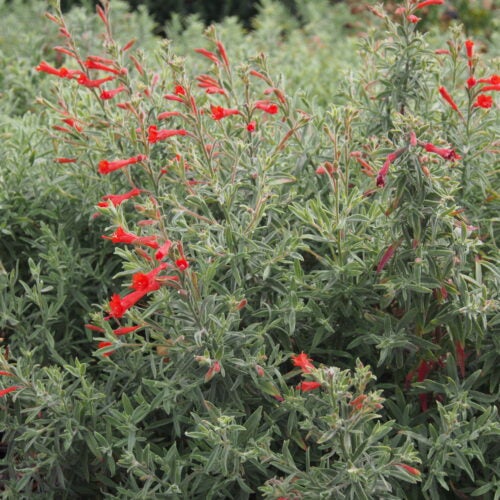
California Fuchsia (Epilobium canum) is a beautiful native perennial groundcover to sub-shrub of the California foothills and coastal areas. It is a perennial plant, notable for the many bright red flowers in summer and autumn. They tend to dormant in the winter, which is a good time to prune the old foliage to encourage new growth in spring. Easy to grow, will do best and flower most profusely in full sun. It can spread by seed and by rhizomes. Great for attracting hummingbirds. This plant is on several fire-resistant plant lists, including FireSafe Marin and County of San Diego.
Beach Aster, Seaside Daisy
Erigeron spp.
CA Native, Ground Cover
Care:
Full Sun
Partial Shade
Low
Most Soils
Look:
Small
size
Blue Green
leaves
Gray Green
leaves
Green - Dark
leaves
Lavender
flowers
White
flowers
Beach Aster, Seaside Daisy
Erigeron spp.
CA Native, Ground Cover
Care:
Full Sun
Partial Shade
Low
Most Soils
Look:
Small
size
Blue Green
leaves
Gray Green
leaves
Green - Dark
leaves
Lavender
flowers
White
flowers
Group of flowering perennials mostly native to North America. Two species are commonly grown in California gardens. Beach aster (E. glaucus, 12” x 2′) is native to coastal California and Oregon and has purple flowers with yellow centers from spring into summer. Santa Barbara daisy (E. karvinskianus, 10-18” x 2-3’) has white and pink flowers with yellow centers. This plant can self-sow aggressively but is easily pulled.
Examples: E. g. ‘Wayne Roderick’ has deep purple flowers. E. g. ‘White Lights’ is a white- flowering form from Sonoma County.
Buckwheat
Eriogonum spp.
CA Native, Shrub
Care:
Full Sun
Very Low
Low
Well Drained
Look:
Medium
size
Small
size
Gray
leaves
Green
leaves
Pink
flowers
White
flowers
Yellow
flowers
Buckwheat
Eriogonum spp.
CA Native, Shrub
Care:
Full Sun
Very Low
Low
Well Drained
Look:
Medium
size
Small
size
Gray
leaves
Green
leaves
Pink
flowers
White
flowers
Yellow
flowers
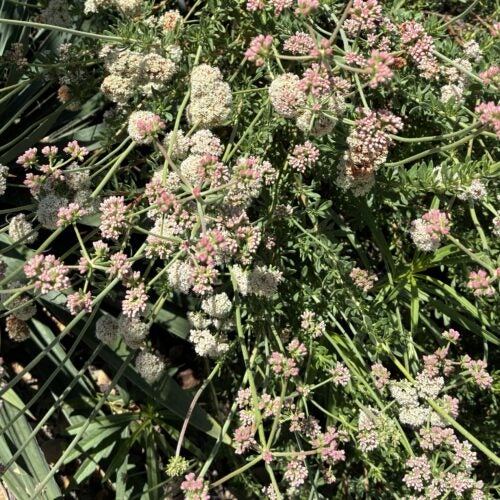
Diverse group of flowering, evergreen shrubs and perennials found throughout the western United States. Most available in nurseries are native to California and generally prefer drier sites. Flowers colors include yellow, white, and pink and are held above foliage in umbels that dry over time and are popular in flower arrangements. Buckwheats provide pollen and nectar for bees and butterflies, larval food for butterflies, seeds for birds, and cover for many creatures.
Examples:
- Santa Cruz Island buckwheat (E. arborescens, 3-4’ x 4-5’) densely mounded with white flowers.
- Saffron buckwheat (E. crocatum, 1-2’ x 2-3’) with chartreuse-yellow flowers and pale leaves.
- California buckwheat (E. fasciculatum, 2-3’ x 3’) and its low-growing cultivars such as E. f. ‘Warriner Lytle.’
- Catherine’s lace (E. giganteum, 4-8’ x 6-10’) with delicate, white flowers and soft pale leaves.
- Red-flowered buckwheat (E. grande var. Rubescens, 1-2’ x 2-3’) low-mounding perennial with rose-pink flowers, coastal bluff buckwheat (E. latifolium, up to 12” x 1-2’.)
- Sulfur buckwheat (E. umbellatum, 6-18” x 1-3’) with intense yellow flowers and cultivars E. u. var. aureum ‘Kannah Creek’ and E. u. Var. ‘Shasta Sulphur’.
Common Woolly Sunflower
Eriophyllum lanatum
CA Native, Ground Cover
Care:
Full Sun
Partial Shade
Low
Well Drained
Look:
Small
size
Green -Light
leaves
Yellow
flowers
Common Woolly Sunflower
Eriophyllum lanatum
CA Native, Ground Cover
Care:
Full Sun
Partial Shade
Low
Well Drained
Look:
Small
size
Green -Light
leaves
Yellow
flowers
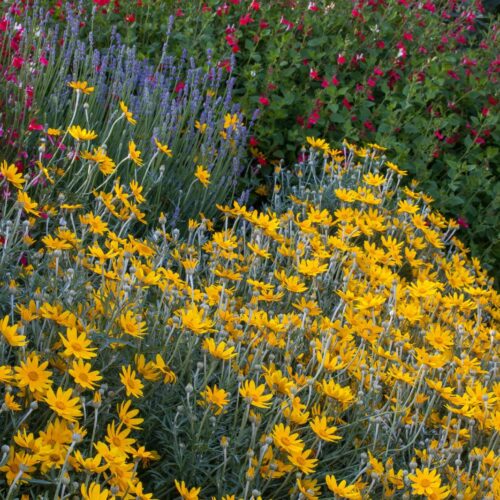
The Common Wooly Sunflower is native to northern California up to British Columbia and east to Wyoming. Many cultivars are available. Generally, they grow less than 1 foot to 2 feet tall and 2-3 feet wide. They have upright stems with wooly leaves and a singular sunflower atop each stem. It tolerates a wide variety of well-draining soils. Cut back in late winter to renew.
Wallflower
Erysimum spp.
Care:
Full Sun
Partial Shade
Low
Most Soils
Look:
Small
size
Green
leaves
Orange
flowers
Pink
flowers
Yellow
flowers
Wallflower
Erysimum spp.
Care:
Full Sun
Partial Shade
Low
Most Soils
Look:
Small
size
Green
leaves
Orange
flowers
Pink
flowers
Yellow
flowers
Short-lived perennials with differing growth habits with flower spikes of small flowers. Erysimum ‘Bowles Mauve’ is a popular hybrid that grows 3’ x 3-4’ and blooms from winter and into spring. Many hybrids with different flower colors are available.
California Poppy
Eschscholzia californica
CA Native
Care:
Full Sun
Partial Shade
Very Low
Most Soils
Look:
Small
size
Blue Green
leaves
Orange
flowers
California Poppy
Eschscholzia californica
CA Native
Care:
Full Sun
Partial Shade
Very Low
Most Soils
Look:
Small
size
Blue Green
leaves
Orange
flowers
The California state flower, the California poppy, is a persistent native wildflower. It is best to plant seeds in fall when the rain begins. Once established, the poppy will reseed and spread across your yard. It is great for bees, birds, butterflies, and other pollinators as well as being deer resistant. Poppies prefer well-drained soils but can tolerate most soils including clay.
Evergreen Eunonymus
Euonymus japonicus
Shrub
Care:
Full Sun
Low
Well Drained
Look:
Medium
size
Green
leaves
Evergreen Eunonymus
Euonymus japonicus
Shrub
Care:
Full Sun
Low
Well Drained
Look:
Medium
size
Green
leaves
Tough shrubs planted for foliage and often used as a screen or hedge. Evergreen euonymus (Euonymus japonicus) has lower water requirements than most other available species and grows 4-10’ x 6’. Plant in full sun with good air circulation to help prevent mildew.
Examples: Variegated examples include: E. j. ‘Aureo-Marginata’ and E. j. ‘Aureo-Variegatus’, E. j. ‘Silver King’, and E. j. ‘Silver Queen’. E. j. ‘Microphyllus’ grows 2’ x 2’ and has small boxwood-like leaves.
Spurge, Euphorbia
Euphorbia spp.
Care:
Full Sun
Low
Well Drained
Look:
Medium
size
Small
size
Blue Green
leaves
Variegated
leaves
Green
flowers
Yellow
flowers
Spurge, Euphorbia
Euphorbia spp.
Care:
Full Sun
Low
Well Drained
Look:
Medium
size
Small
size
Blue Green
leaves
Variegated
leaves
Green
flowers
Yellow
flowers
Large and variable group of several thousand plants that vary in both form and water requirements. Caution: Some euphorbias reseed readily, and all have milky white sap that is irritating to skin and poisonous.
Low-water examples: Mediterranean spurge (E. characias, 3-4’ x 3-4’) and E. c. spp. Wulfenii offer large clusters of flower bracts; creeping spurge (E. myrsinites, 6-12” x 12-18”); Martin euphorbia (E. x martinii & cvs, 2-3’ x 2-3’) offers a more compact shrub form than Mediterranean spurge with brown-centered chartreuse flowers.
Pineapple Guava
Feijoa (Acca) sellowiana
Shrub, Tree
Care:
Full Sun
Partial Shade
Very Low
Low
Well Drained
Look:
Medium
size
Gray Green
leaves
Green - Dark
leaves
Pink
flowers
Red
flowers
White
flowers
Brown
bark
Pineapple Guava
Feijoa (Acca) sellowiana
Shrub, Tree
Care:
Full Sun
Partial Shade
Very Low
Low
Well Drained
Look:
Medium
size
Gray Green
leaves
Green - Dark
leaves
Pink
flowers
Red
flowers
White
flowers
Brown
bark
Once established, the pineapple guava tree or shrub needs little irrigation. The plant grows slowly over the course of a few years and can reach 15-25 feet in height if allowed, though it may be kept to a size of 8×8 feet if pruned regularly. Heavy pruning in the early spring will ensure a desired shape.
The tree produces small, edible green fruit which naturally fall from the tree in late October-December. Its white and pink flowers bloom in spring or early summer to provide nectar for bees and birds, which ignore the fruit. Likewise, deer seem to be uninterested in this plant.
Fescue
Festuca spp.
CA Native, Grass
Care:
Full Sun
Partial Shade
Very Low
Low
Well Drained
Look:
Small
size
Blue Green
leaves
Gray Green
leaves
Green
leaves
Fescue
Festuca spp.
CA Native, Grass
Care:
Full Sun
Partial Shade
Very Low
Low
Well Drained
Look:
Small
size
Blue Green
leaves
Gray Green
leaves
Green
leaves
Large group of mostly cool-season, perennial, bunching or spreading grasses. Bunch grass varieties can be used as a no-mow lawn replacement, help to stabilize slopes, and have ornamental value. Festuca californica (California fescue, 1-2’ wide x 2’) prefers part shade and works wonderfully massed under the dry shade of native oaks. Festuca glauca (blue fescue, 1’ x 1’) is a small, clumping grass with bluish gray-green leaves. Festuca idahoenis (Idaho fescue, 1-2’ wide x 1’) also has bluish gray-green leaves and is more drought-tolerant and longer lived than blue fescue. Festuca rubra (red fescue) grows from rhizomes and has long, fine-textured leaves that lay over to form a pleasing drift effect as a no-mow lawn.
Print this plant card