Water conservation is an essential consideration when designing and managing Sonoma and Marin County landscapes. Our area enjoys a Mediterranean climate characterized by wet winters and long, dry summers with little rainfall. Plants that are suited or adapted to local conditions not only use less water but generally grow more successfully and robustly, with fewer insect and disease problems. They ultimately create a healthier, more beautiful and more sustainable landscape.
Below is a hand selected plant list for Sonoma and Marin counties that displays mostly native species that will thrive in our climate. You can search, filter and save specific plants to your plant list and also print plant cards.
-
California Native
Honeysuckle
Lonicera spp -
Fringe Flower
Loropetalum chinese -
California Native
Lupine
Lupinus spp -
California Native
Catalina Ironwood
Lyonothamnus floribundus ssp aspleniifolius -
California Native
Oregon Grape, Berberry
Mahonia [Berberis] spp -
California Native
Tree Mallow
Malva assurgentiflora -
California Native
Sticky Monkey Flower
Mimulus (Diplacus) aurantiacus and hybrids -
California Native
Coyote Mint
Monardella villosa -
California Native
Muhly Grass, Deer Grass
Muhlenbergia spp -
Prostrate Myoporum
Myoporum parvifolium -
African Boxwood
Myrsine africana -
Common Myrtle
Myrtus communis
Honeysuckle
Lonicera spp
CA Native, Shrub, Vine
Care:
Full Sun
Partial Shade
Low
Well Drained
Look:
Green
leaves
Pink
flowers
White
flowers
Yellow
flowers
Honeysuckle
Lonicera spp
CA Native, Shrub, Vine
Care:
Full Sun
Partial Shade
Low
Well Drained
Look:
Green
leaves
Pink
flowers
White
flowers
Yellow
flowers
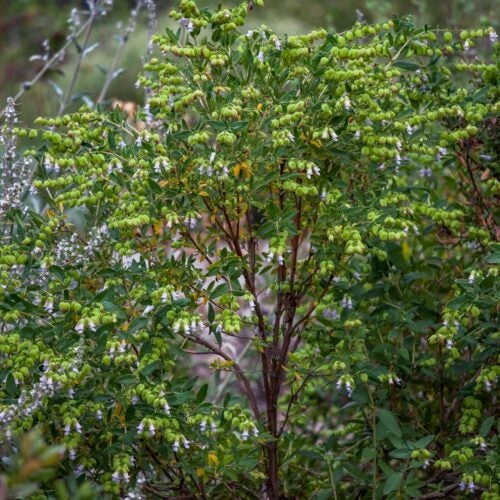
Honeysuckle is a varied group of evergreen and deciduous shrubs and vines with fragrant, tubular flowers. Several species are native to California and are well suited to gardens in Sonoma and Marin counties. Flowers are attractive to bees and hummingbirds and berries provide food for birds.
Examples: California honeysuckle (Lonicera hispidula) is a deciduous, vining shrub often seen growing in woodland environments. Cream and pink flower clusters in spring are followed by red berries in late summer. Twinberry (Lonicera involucrata, 6-10’ x 6-10’) is a deciduous shrub that typically grows along streams and other moist places. Tubular, red and yellow flowers grow in pairs, followed by dark pairs of berries. Provide light shade in warmer locations.
Fringe Flower
Loropetalum chinese
Shrub
Care:
Full Sun
Partial Shade
Low
Loam
Look:
Large
size
Medium
size
Green
leaves
Green
flowers
White
flowers
Fringe Flower
Loropetalum chinese
Shrub
Care:
Full Sun
Partial Shade
Low
Loam
Look:
Large
size
Medium
size
Green
leaves
Green
flowers
White
flowers
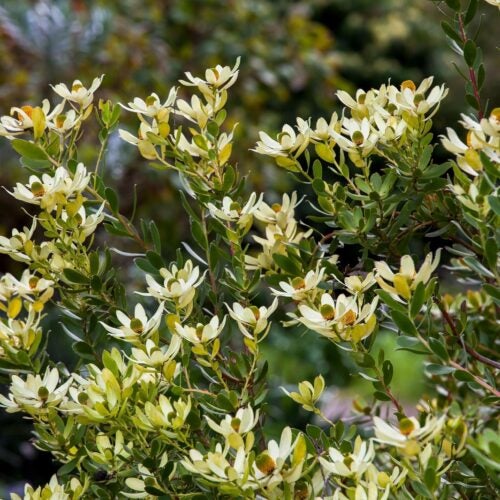
Attractive, Chinese evergreen shrub with gently drooping branches and unusual flowers with thread-like petals in the spring. Commonly available either with green leaves and white flowers, or purple leaves and pink flowers. Well suited to understory locations with partial shade in hotter locations. Grows naturally as a shrub but may be available as a standard or espalier.
Lupine
Lupinus spp
CA Native, Shrub
Care:
Full Sun
Very Low
Well Drained
Look:
Medium
size
Small
size
Green
leaves
Silver
leaves
Blue
flowers
Violet
flowers
Yellow
flowers
Lupine
Lupinus spp
CA Native, Shrub
Care:
Full Sun
Very Low
Well Drained
Look:
Medium
size
Small
size
Green
leaves
Silver
leaves
Blue
flowers
Violet
flowers
Yellow
flowers
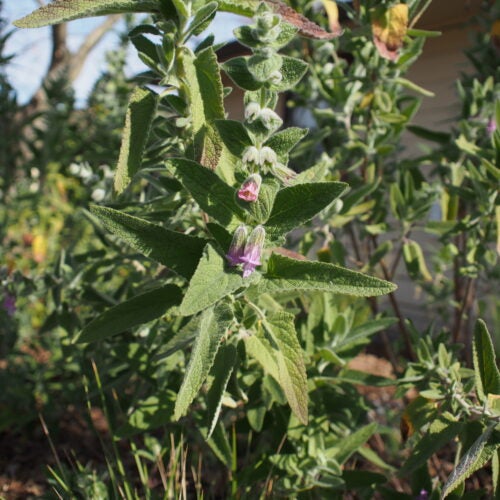
Popular group of annuals, perennials, and shrubs with distinctive divided leaves that are common throughout the western United States, including California. Pea-like flowers are displayed on spikes and are attractive to bees and other pollinators. Most native lupines are purple-flowered, while some are yellow. Provide full sun and good drainage and watch out for slugs and snails.
Examples: Silver bush lupine (L. albifrons, 3-4’ x 3-4’), prostate lupine (L. albifrons var. collinus, 12-18” x 12-18”), coastal bush lupine (L. arboreus) available with either blue or yellow flowers but can be invasive in some north coastal dunes, and blue-and-white lupine (L. bicolor) a low-growing, annual wildflower.
Catalina Ironwood
Lyonothamnus floribundus ssp aspleniifolius
CA Native, Tree
Care:
Full Sun
Partial Shade
Low
Well Drained
Look:
Large
size
Medium
size
Green
leaves
White
flowers
Catalina Ironwood
Lyonothamnus floribundus ssp aspleniifolius
CA Native, Tree
Care:
Full Sun
Partial Shade
Low
Well Drained
Look:
Large
size
Medium
size
Green
leaves
White
flowers
This medium-to-large, evergreen Channel Island native tree offers fern-like leaves, peeling bark, and large, flat-topped, creamy white flower clusters in spring or summer. Flowers are attractive to pollinating insects and birds and gradually turn brown. Leaf fall from the tree provides a layer of mulch to the drip line.
Oregon Grape, Berberry
Mahonia [Berberis] spp
CA Native, Shrub
Care:
Full Sun
Low
Well Drained
Look:
Green
leaves
Yellow
flowers
Oregon Grape, Berberry
Mahonia [Berberis] spp
CA Native, Shrub
Care:
Full Sun
Low
Well Drained
Look:
Green
leaves
Yellow
flowers
Some barberries may be referred to either as Berberis or Mahonia. The California species are a group of evergreen shrubs with glossy, spiny-edged leaves and clusters of yellow flowers in spring followed by small grape-like berries attractive to birds. Barberry foliage provides a display through the year as new leaf growth is often bronzy red that gives way to green- and finally purple-red tones in the winter months.
Examples: Oregon grape (M. repens, 1-3’ x 2-3’) is an excellent small-scale groundcover for lightly shaded understory locations; Nevin mahonia (M. nevinii, 6-8’ x 6-8’) with blue-green leaves from Southern California is a good screen plant; and California holly grape (M. pinnata, 4-6’ x 4-6’) with wavy leaves provides distinctive texture.
Tree Mallow
Malva assurgentiflora
CA Native, Shrub
Care:
Full Sun
Partial Shade
Low
Well Drained
Look:
Large
size
Green
leaves
Pink
flowers
White
flowers
Brown
bark
Tree Mallow
Malva assurgentiflora
CA Native, Shrub
Care:
Full Sun
Partial Shade
Low
Well Drained
Look:
Large
size
Green
leaves
Pink
flowers
White
flowers
Brown
bark
Native to the Channel Islands of southern California and naturalized along the California coast, this large, tree-like shrub sports showy pink flowers resembling hibiscus for much of the year. It grows quickly to 8-12 feet tall and 5-10 feet wide in sun to part shade and most well-drained soils. Prune branches back annually to maintain a compact form. May also be under “Lavatera assurgentiflora.”
Sticky Monkey Flower
Mimulus (Diplacus) aurantiacus and hybrids
CA Native, Shrub
Care:
Full Sun
Partial Shade
Very Low
Sandy
Look:
Green
leaves
Orange
flowers
Red
flowers
White
flowers
Sticky Monkey Flower
Mimulus (Diplacus) aurantiacus and hybrids
CA Native, Shrub
Care:
Full Sun
Partial Shade
Very Low
Sandy
Look:
Green
leaves
Orange
flowers
Red
flowers
White
flowers
The orange, tubular flowers of sticky monkey flower can be enjoyed in many locations throughout Sonoma and Marin counties in spring and summer, a testament to how well this plant is adapted to hot and dry conditions. The slightly sticky leaves benefit from light pinching and pruning to maintain an attractive appearance and support for the beautiful flowers. Many hybrids provide color variation. Do not confuse this plant with the red-flowered scarlet monkey flower (Mimulus cardinalis), an herbaceous riparian plant that requires regular water to thrive.
Coyote Mint
Monardella villosa
CA Native
Care:
Full Sun
Very Low
Most Soils
Look:
Gray Green
leaves
Purple
flowers
Coyote Mint
Monardella villosa
CA Native
Care:
Full Sun
Very Low
Most Soils
Look:
Gray Green
leaves
Purple
flowers
Coyote Mint is a compact perennial or sub-shrub with aromatic foliage and a sprawling habit. Dense heads of purple flowers form in spring-to-summer that are attractive to butterflies and other insects. The low-growth habit of coyote mint makes it an excellent choice for the front of a border, along the edge of a path, or beneath larger shrubs such as manzanita or ceanothus. Monardella villosa spp. franciscana ‘Russian River’ and Monardella villosa spp. villosa ‘Mark West’ are available selections from Sonoma County.
Muhly Grass, Deer Grass
Muhlenbergia spp
CA Native, Grass
Care:
Full Sun
Partial Shade
Low
Well Drained
Look:
Green
leaves
Cream
flowers
Pink
flowers
Muhly Grass, Deer Grass
Muhlenbergia spp
CA Native, Grass
Care:
Full Sun
Partial Shade
Low
Well Drained
Look:
Green
leaves
Cream
flowers
Pink
flowers
Large, showy, clumping, warm-season grasses native to the Southern United States, Mexico, and Central and South America. Can be grown in masses but require sufficient space for the mature size and form to develop. Arching plumes of flowers on long stalks provide significant ornamental value to these low-maintenance and drought-tolerant grasses.
Examples: Pink muhly (M. capillaris, 2-3′ x 2-3’) with feathery pink flowers; pine muhly (M. dubia, 2-3’ x 2-3’) with light purple flowers; Lindheimer muhly (M. lindheimeri, 3-5’ x 4-5’) with creamy yellow flowers that provide a pronounced display; and the California native deer grass (M. rigens, 3’ x 3-4’).
Prostrate Myoporum
Myoporum parvifolium
Ground Cover
Care:
Full Sun
Low
Well Drained
Look:
Green
leaves
White
flowers
Prostrate Myoporum
Myoporum parvifolium
Ground Cover
Care:
Full Sun
Low
Well Drained
Look:
Green
leaves
White
flowers
Low-growing, Australian evergreen groundcover shrub that forms a mat about 6” high and 10’ wide with small, white flowers in the summer.
African Boxwood
Myrsine africana
Shrub
Care:
Full Sun
Partial Shade
Low
Well Drained
Look:
Green - Dark
leaves
African Boxwood
Myrsine africana
Shrub
Care:
Full Sun
Partial Shade
Low
Well Drained
Look:
Green - Dark
leaves
Dense, evergreen shrub with small leaves that will eventually grow to 4-6’ high and wide. Boxwood is commonly clipped as a small hedge, topiary, or kept in a container.
Common Myrtle
Myrtus communis
Shrub
Care:
Full Sun
Partial Shade
Low
Well Drained
Look:
Green - Dark
leaves
White
flowers
Common Myrtle
Myrtus communis
Shrub
Care:
Full Sun
Partial Shade
Low
Well Drained
Look:
Green - Dark
leaves
White
flowers
Mediterranean evergreen shrub with fine-textured, aromatic foliage that withstands shearing and makes a good informal hedge or screen. Several available cultivars provide different growth and foliage characteristics.
Print this plant card