Water conservation is an essential consideration when designing and managing Sonoma and Marin County landscapes. Our area enjoys a Mediterranean climate characterized by wet winters and long, dry summers with little rainfall. Plants that are suited or adapted to local conditions not only use less water but generally grow more successfully and robustly, with fewer insect and disease problems. They ultimately create a healthier, more beautiful and more sustainable landscape.
Below is a hand selected plant list for Sonoma and Marin counties that displays mostly native species that will thrive in our climate. You can search, filter and save specific plants to your plant list and also print plant cards.
-
California Native
Sage
Salvia spp. -
California Native
Elderberry
Sambucus spp. -
Lavender Cotton
Santolina spp. -
Sweet Box
Sarcococca spp. -
California Native
Yerba Buena
Satureja [Clinopodium] douglasii -
California Native
Bee Plant
Scrophularia californica -
Stonecrop
Sedum spp. -
Houseleek
Sempervivum spp. -
Senecio
Senecio spp. -
California Native
Blue-Eyed Grass
Sisyrinchium bellum -
California Native
California Goldenrod
Solidago velutina californica -
Australian Bluebell Creeper
Sollya heterophylla
Sage
Salvia spp.
CA Native, Ground Cover, Shrub
Care:
Full Sun
Partial Shade
Very Low
Low
Well Drained
Look:
Medium
size
Small
size
Gray
leaves
Green
leaves
Lavender
flowers
Pink
flowers
Purple
flowers
Red
flowers
White
flowers
Sage
Salvia spp.
CA Native, Ground Cover, Shrub
Care:
Full Sun
Partial Shade
Very Low
Low
Well Drained
Look:
Medium
size
Small
size
Gray
leaves
Green
leaves
Lavender
flowers
Pink
flowers
Purple
flowers
Red
flowers
White
flowers
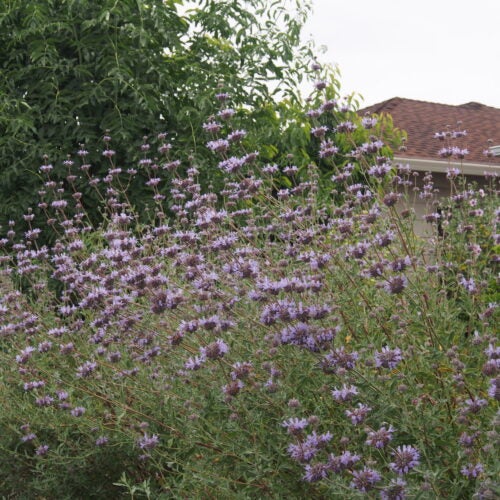
Salvias are a huge group of more than 900 species that include annuals, perennials, and shrubs adapted to a variety of climates and have varying water requirements. Salvias are attractive to hummingbirds, butterflies, and bees, and are generally ignored by deer. Sages that are native to California are generally drought-tolerant, prefer full sun, and little to no fertilizer. Annual pruning in late summer or fall generally helps to keep plants tidy and healthy.
CA native sages:
- S. apiana, white sage (3-4’ x 4-6’), silvery-white, aromatic leaves with tall flower spikes of white flowers, popular for honey production and in bundles as a natural incense.
- S. ‘Bee’s Bliss’, (1-2’ x 6-8’), superb, light gray groundcover with light purple flowers on long spikes; damp conditions can cause mildew which will clear with warm weather and sunny conditions.
- S. clevelandii, Cleveland sage (3-5’ x 3-5’), medium-sized shrub for hot, dry locations known for pleasant fragrance and deep blue whorls of flowers; popular cultivars include S. c. ‘Allen Chickering’, S. c. ‘Pozo Blue’, and S. c. ‘Winnifred Gilman’.
- S. leucophylla, purple sage, includes plants with both an upright growth habit, such as S. l. ‘Amethyst Bluff’ (3-5’ x 3-5’) and others with a sprawling form, such as S. l. ‘Point Sal’ (2-3’ x 6’), both of which are from Santa Barbara county.
- S. sonomaensis, Sonoma sage (1-2’ x 3-4’), groundcover that prefers light shade and will not tolerate damp conditions; cultivars include S. s. ‘Dara’s Choice’ and S. s. ‘Greenberg Gray’.
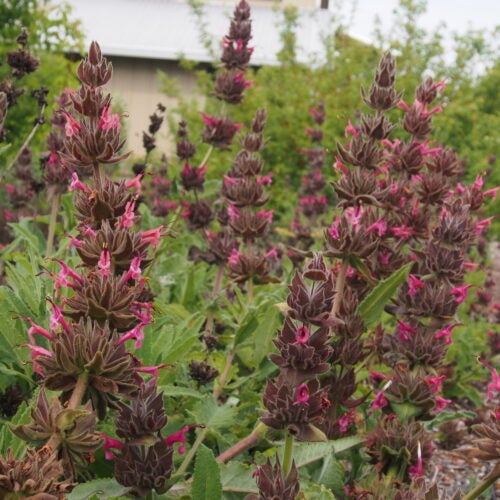
- S. spathacaea, Hummingbird Sage (1-2’ tall and 4-5 feet wide), herbaceous groundcover that grows well in dry shade and spreads slowly by underground rhizomes; large leaves have a wonderful fruity fragrance. Pink to dark rose flowers from late winter into summer. It is drought tolerant and can survive without summer irrigation once established. Some supplemental water will keep the foliage green.
- S. mellifera, black sage (6′ x 10′), evergreen shrub that grows well in full sun and well drained soils. Dark green leaves with pale purple flowers in late spring and early summer.
Non-native low-water use sages:
- S. chamaedryoides, germander sage (2-3’)
- S. greggii, autumn sage (1-4’ x 1-4’)
- S. leucantha, Mexican bush sage (3-4’ x 3-6’)
- S. microphylla, cherry sage (3-4’ x 3-6’)
- S. officinalis, garden sage (1-3’ x 1-3’)
Elderberry
Sambucus spp.
CA Native, Shrub, Tree
Care:
Full Sun
Partial Shade
Low
Most Soils
Look:
Medium
size
Green
leaves
White
flowers
Elderberry
Sambucus spp.
CA Native, Shrub, Tree
Care:
Full Sun
Partial Shade
Low
Most Soils
Look:
Medium
size
Green
leaves
White
flowers
Fast-growing shrubs and small trees for sun or part shade that attract pollinators from far and wide to large clusters of cream flowers in spring, followed by berries in summer that provide food to many types of birds. Fruit can also be used for culinary purposes. While naturally fairly wild-looking, elderberries can handle being cut back to the ground in the winter or pruned to maintain size and shape. Drought tolerant but can tolerate seasonal moisture, good choice for rain gardens.
Examples:
- Blue elderberry (S. mexicana [nigra] spp. caerulea, 8-25’) is native from Oregon to Baja California and beyond.
- Black elderberry (S. nigra, 20-30’) is native to Europe, North Africa, and Asia, and is available in nurseries in the form of many named cultivars. Cut leaf black elderberry (S. n. ‘Black Lace’, 8’ x 8’) has intense dark, fine foliage. Cut leaf elderberry (S. n. ‘Laciniata’, 10’ x 10’) has green leaves, and variegated black elderberry (S. n. ‘Marginata’, 6-12’) has variegated leaves.
Lavender Cotton
Santolina spp.
Shrub
Care:
Full Sun
Low
Well Drained
Look:
Medium
size
Small
size
Gray
leaves
Green
leaves
Yellow
flowers
Lavender Cotton
Santolina spp.
Shrub
Care:
Full Sun
Low
Well Drained
Look:
Medium
size
Small
size
Gray
leaves
Green
leaves
Yellow
flowers
Small, mounding, aromatic Mediterranean shrubs that flower in summer with small yellow, button-like flowers. Prune in spring after flowering to maintain appearance. Two widely available species are lavender cotton (S. chamaecyparissus, 1-2’ x 2-3’) with gray-green foliage, and S. rosmarinifolia (1-2’ x 2-3’) with green foliage that resembles rosemary.
Sweet Box
Sarcococca spp.
Shrub
Care:
Partial Shade
Shade
Low
Loam
Look:
Medium
size
Small
size
Green
leaves
White
flowers
Sweet Box
Sarcococca spp.
Shrub
Care:
Partial Shade
Shade
Low
Loam
Look:
Medium
size
Small
size
Green
leaves
White
flowers
Shade-loving, low maintenance, evergreen shrub with glossy green leaves from the Himalayas and China. Small, fragrant, white flowers in late winter and early spring are followed by blue-black or red berries. S. hookerana humilis (1-2’ x 4-8’) is a low-growing form that spreads by underground runners. S. ruscifolia (4-6’ x 3-7’) is an upright shrub form.
Yerba Buena
Satureja [Clinopodium] douglasii
CA Native, Ground Cover
Care:
Partial Shade
Shade
Low
Most Soils
Look:
Small
size
Green
leaves
Lavender
flowers
White
flowers
Yerba Buena
Satureja [Clinopodium] douglasii
CA Native, Ground Cover
Care:
Partial Shade
Shade
Low
Most Soils
Look:
Small
size
Green
leaves
Lavender
flowers
White
flowers
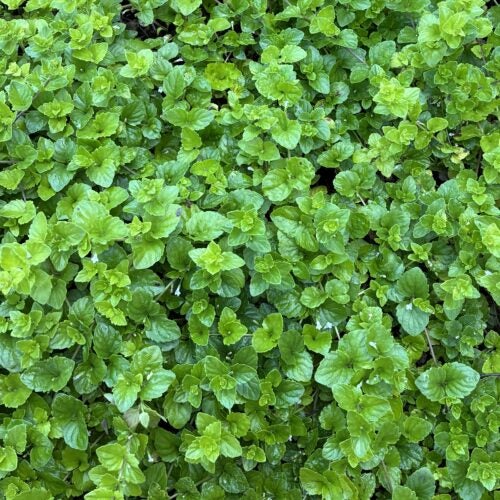
Yerba buena is Spanish for “good herb” due to its medicinal qualities as a tea. This California native trailing herbaceous perennial is evergreen and has a minty fragrance. Small white to pale lavender flowers appear in spring. Grows just a few inches tall and about 3 feet wide, making a fantastic groundcover for shade. Prefers a woodland setting with light shade and well-drained soil.
Bee Plant
Scrophularia californica
CA Native
Care:
Partial Shade
Shade
Low
Well Drained
Look:
Medium
size
Small
size
Blue Green
leaves
Red
flowers
Bee Plant
Scrophularia californica
CA Native
Care:
Partial Shade
Shade
Low
Well Drained
Look:
Medium
size
Small
size
Blue Green
leaves
Red
flowers
This California native plant is extremely attractive to bees, but also helps hummingbirds, and butterflies. It grows well in dry shade and most soils. It grows to 3-4 feet tall and less than a foot wide. In moist soils it will form large colonies, but it can also successfully be grown in a pot. Bee Plant flowers are small enough that you might miss them upon first glance, but when backlight by the sun, they look like tiny red jewels. Best incorporated as part of a perennial border, typically near the back as it is a taller plant. Tolerates seasonal moisture and can be included in a rain garden.
Stonecrop
Sedum spp.
Ground Cover, Succulent
Care:
Full Sun
Partial Shade
Low
Well Drained
Look:
Small
size
Gray Green
leaves
Green
leaves
Reddish
leaves
Variegated
leaves
Pink
flowers
Red
flowers
White
flowers
Yellow
flowers
Stonecrop
Sedum spp.
Ground Cover, Succulent
Care:
Full Sun
Partial Shade
Low
Well Drained
Look:
Small
size
Gray Green
leaves
Green
leaves
Reddish
leaves
Variegated
leaves
Pink
flowers
Red
flowers
White
flowers
Yellow
flowers
Large group of succulent, drought tolerant plants that vary considerably in appearance and cold tolerance. Sedums can provide variety in texture among other plants and also work well in containers.
Examples:
- S. rupestre ‘Angelina’ has brilliant chartreuse-yellow, needle-like foliage that forms a striking groundcover.
- S. spathulifolium is a mat-forming, evergreen perennial native to California’s coast ranges and Sierra Nevada to British Columbia. Yellow, star-like flowers appear in late spring and early summer. S. s. ‘Cape Blanco’ has chalky-white foliage and S. s. ‘Purpureum’ has purple foliage.
- S. spurium is a ground-hugging succulent with trailing stems and small dark green, bronzy leaves about an inch long, and bears pink, white, or purple flowers in mid-summer. S. s. ‘Dragon’s Blood’ has red-margined, green leaves that become brilliantly red with cool autumn temperatures. S. s. ‘Bronze Carpet’ bears rich bronze-red foliage with pink flowers. S. s. ‘Tricolor’ leaves are variegated in green, creamy white, and pink.
Houseleek
Sempervivum spp.
Ground Cover, Succulent
Care:
Full Sun
Partial Shade
Low
Well Drained
Look:
Small
size
Gray Green
leaves
Green
leaves
Pink
flowers
Red
flowers
White
flowers
Yellow
flowers
Houseleek
Sempervivum spp.
Ground Cover, Succulent
Care:
Full Sun
Partial Shade
Low
Well Drained
Look:
Small
size
Gray Green
leaves
Green
leaves
Pink
flowers
Red
flowers
White
flowers
Yellow
flowers
Small, hardy succulents form rosettes of tightly packed, pointed leaves that come in a wide variety of forms colors and textures. All spread by offsets that cluster around the parent. Small, star-shaped flowers on fleshy stems in the summer.
Examples:
- Cobweb houseleek (S. arachnoideum, 3” and spreading) has web-like hairs on leaves.
- Hens and chicks (S. tectorum, 4-12” and spreading) are available in many cultivars.
Senecio
Senecio spp.
Succulent
Care:
Full Sun
Partial Shade
Low
Well Drained
Look:
Small
size
Blue
leaves
Blue Gray
leaves
White
flowers
Yellow
flowers
Senecio
Senecio spp.
Succulent
Care:
Full Sun
Partial Shade
Low
Well Drained
Look:
Small
size
Blue
leaves
Blue Gray
leaves
White
flowers
Yellow
flowers
Just a few plants from this vast group of plants are widely available in nurseries in California.
Examples:
- Dusty miller (S. cineraria, 2-3’ x 2-3’) is a Mediterranean perennial with white-gray leaves that produces clusters of cream or yellow flowers throughout the year.
- Blue chalksticks (S. mandraliscae, 1-2’ x 2-3’) is a spreading succulent from South Africa with fleshy, finger-like leaves up to 6” long.
- Blue Chalksticks (S. serpens, 6” x 1’) is similar to S. mandraliscae but is smaller and has shorter leaves of up to 2”.
Blue-Eyed Grass
Sisyrinchium bellum
CA Native
Care:
Full Sun
Partial Shade
Low
Most Soils
Look:
Small
size
Green
leaves
Purple
flowers
Blue-Eyed Grass
Sisyrinchium bellum
CA Native
Care:
Full Sun
Partial Shade
Low
Most Soils
Look:
Small
size
Green
leaves
Purple
flowers
Blue-eyed Grass is a 0.5 – 1 ft. tall and wide perennial herb with narrow, green leaves resembling iris and purplish-blue flowers with yellow centers in late winter and spring. Summer semi-deciduous. Easy to grow and may self-sow. Native to woodlands and grasslands from Oregon to northwestern Baja California.
California Goldenrod
Solidago velutina californica
CA Native
Care:
Full Sun
Partial Shade
Low
Moderate
Most Soils
Look:
Small
size
Gray Green
leaves
Yellow
flowers
California Goldenrod
Solidago velutina californica
CA Native
Care:
Full Sun
Partial Shade
Low
Moderate
Most Soils
Look:
Small
size
Gray Green
leaves
Yellow
flowers
California native perennial herb with oval shaped, gray-green leaves. Yellow flowers will appear in the summer and early fall. Natural habitat for birds and pollinating insects and tolerates a wide variety of soils.
Australian Bluebell Creeper
Sollya heterophylla
Ground Cover, Shrub
Care:
Partial Shade
Shade
Low
Well Drained
Look:
Medium
size
Small
size
Green - Dark
leaves
Blue
flowers
Australian Bluebell Creeper
Sollya heterophylla
Ground Cover, Shrub
Care:
Partial Shade
Shade
Low
Well Drained
Look:
Medium
size
Small
size
Green - Dark
leaves
Blue
flowers
Evergreen shrub or vine from Australia with glossy green leaves and clusters of small, bell-shaped, blue flowers in summer. Can be grown as a low-growing shrub or trained onto a support. Requires good drainage but will grow with full sun or some shade.
Print this plant card